

Absolute Zero: The Chilling Power and Heated Promises of Quantum Computing
A field guide to the hype, the geopolitics, and the strange logic of a technology still warming up.

Quantum physics certainly represents the greatest advancement in physics to date. While the hopes it carries, particularly in the field of Quantum Computing for sectors as varied as medicine, logistics, or finance, are immense, they do not erase the threats it poses to our cybersecurity. While some are already announcing the “Quantum Apocalypse,” where do we really stand in the development of quantum computers? Will we soon be able to read all of others’ “dirty secrets”? What are the potential geopolitical implications of a complete obsolescence of our encryption systems? Conversely, what advancements can we truly expect from “Quantum Supremacy”?
What is Quantum Physics?
To fundamentally understand what the quantum realm represents, we must first change our scale. Let’s travel into the world of the infinitely small: atoms, photons, and electrons, where everything is singularly different from what we know in the human world. In classical physics, we daily experience so-called “Newtonian” phenomena such as gravity, force, inertia, or speed, making the logic that governs our lives primarily binary. The state of a thing is necessarily one or the other. A coin is necessarily heads or tails; a light is either on or off.
Principles like superposition completely nullify this concept in quantum physics, where a quantum particle can be in two states at once. This principle is often illustrated by Schrödinger’s Cat, an experiment in which a cat is locked in a box with a device that kills the animal as soon as it detects the decay of a radioactive atom (which has a 50% probability). Because the state of the cat is linked to the state of the particles, the cat would also be in a superposition of states and therefore both alive and dead as long as the box remains closed.
For those who find the experiment slightly macabre, you can imagine the state of a coin tossed in the air during a game of heads or tails; it is both heads and tails as long as it has not landed.
In reality, macroscopic objects quickly lose their quantum behavior due to interactions with environmental elements that force a system to “choose” a state, also known as decoherence. In the case of Schrödinger’s Cat, this is the moment the door is opened.
Another phenomenon unique to quantum physics is entanglement. A principle described by Einstein as “spooky action at a distance,” it suggests that when two particles become linked, measuring the state of one particle allows one to determine the state of the other, regardless of the distance between them.
From Bits to Qubits
This distinction implies a fundamental difference between a classical computer and a quantum computer. Indeed, the quantum computer relies on the very phenomena of superposition and entanglement.
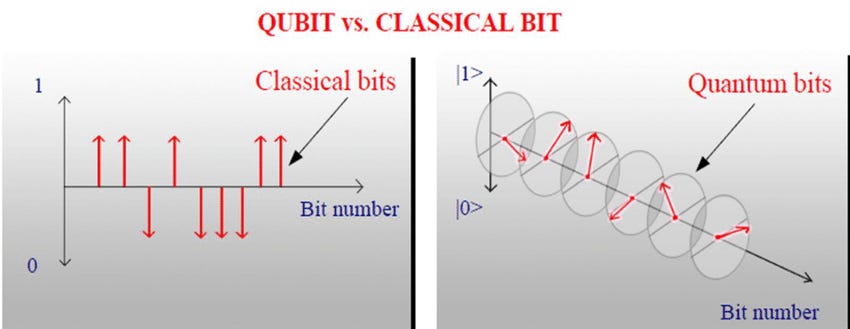
A classical computer uses bits, small quantities of information that can be worth either 1 or 0, and only three rules: NOT, AND, and OR. A quantum computer uses qubits, which, thanks to superposition, can be 0, 1, or both at the same time. Furthermore, qubits evolve in 3D and can therefore be oriented in any direction within these three dimensions. Consequently, there are at least 6 rules that can be applied to them, including the X, Y, Z, Hadamard, Phase, and T gates. Entanglement also applies to qubits, making various multi-qubit gates possible, such as the CNOT gate.
These fundamental differences imply a vast difference in terms of computing power. A classical computer processes calculations sequentially; if 4 bits represent a number between 0 and 15, it must test all 16 possibilities and thus perform 16 calculations. In contrast, 4 qubits can be in all 16 states at once, and the growth is exponential since each added qubit doubles the computing power. For example, 300 qubits represent more states than there are atoms in the universe.
The difference between a classical and a quantum computer lies not so much in calculation speed as in the difference of approach. This is why a quantum computer has no value compared to a classical computer for tasks like searching the internet, streaming your favorite content, sending emails, or working on Excel. This is without mentioning the costs involved in using a quantum computer, whose operation requires extreme, almost extraterrestrial conditions. Unlike your laptop, which dissipates heat with a simple fan, current quantum processors (notably superconducting ones) must be maintained at temperatures nearing absolute zero, or approximately -273°C, a temperature colder than the vacuum of space.
This requirement necessitates colossal infrastructures called dilution refrigerators, whose acquisition cost is measured in millions of dollars and whose electricity consumption to maintain this cold is astronomical. Launching a simple Google search on such a machine would be like using a particle accelerator to light a candle: it is an energetic and financial nonsense. Moreover, the “coherence time,” the duration during which qubits remain stable before collapsing, is so short (a few microseconds) that each calculation must be of immense strategic value to justify such a deployment of resources.
Computing Power at the Service of Espionage: Will we be able to read all your dirty secrets?
Starting in 1970, theoretical models were developed to achieve the ambitions of quantum computing. As early as 1984, cryptologists Charles H. Bennett and Gilles Brassard proposed the first secure key exchange protocol using quantum communication. Not requiring quantum calculation per se, this protocol uses quantum states solely to detect anyone wishing to eavesdrop on communications. Research culminated in 1994, thanks to the work of Peter Shor, a researcher at MIT, and his discovery of a quantum factorization algorithm. This algorithm theoretically allows for the factorization of large numbers in polynomial time, a task that would take a classical computer several million years and could be completed in a few hours or even minutes by a super-powerful quantum computer relying on a few thousand quantum particles or qubits. This discovery is heavy with meaning for much of the computer security systems used today.
Indeed, the principle of cryptography, securing our computer data, relies on mathematical operations that are very easy to perform in one direction but extremely difficult in the other.
The most well-known encryption method, RSA, was invented in 1977 by three MIT mathematicians (Rivest, Shamir, and Adleman) and is based on a simple principle: it is very easy to multiply two large prime numbers together but very difficult to factor them (to do the reverse). It is on this asymmetry that most of our computer security rests. For example, during a bank transaction, the bank’s browser and yours exchange public keys to encrypt information. To decrypt them, a private key is necessary; it is theoretically possible to find it from a public key, but very complicated. This principle could prove obsolete due to Shor’s discoveries.
Indeed, a quantum computer would be capable of breaking RSA keys; however, to do so, a capacity of several thousand stable, error-corrected qubits would be necessary. Current quantum computers are still far from this “super capacity,” having only a few hundred or thousand unstable qubits.
Qubits are very fragile: the slightest vibration, temperature change, or cosmic ray can destroy superposition and thus ruin a calculation.
The progress shown is rapid but sometimes misleading. In 2019, Google announced Quantum Supremacy with its 53-qubit Sycamore processor, an announcement that was highly controversial due to the very principle of the benchmark used (Random Circuit Sampling or RCS, where the quantum computer is asked to sample from the probability distribution of outputs generated by a random quantum circuit, which is a calculation with no inherent value). It was also controversial because of the time saved compared to a classical computer, initially estimated at 10,000 years, which dropped to a few hours within a few months thanks to the work of “classical” researchers or engineers piqued by the challenge.
The “big day” when quantum computers will be capable of breaking classical cryptography systems, including RSA, is called Q-Day. It is a day from which we are, in principle, still far; experts estimate its arrival in 10 to 15 years. However, there is a good chance it is inevitable, and the stakes are real because the threats are present.
Geopolitically, the stakes are obvious and can recall, to a certain extent, the space race or the nuclear race. Once again, “the winner will take it all”: the first nation to reach true quantum supremacy will be endowed with a power far superior to others by accessing data pertaining to national security.
And the major nations are already on the offensive, with intelligence services such as the NSA, the FSB, or the Chinese Gongabu likely already collecting data and storing it in anticipation of being able to decrypt it when the quantum computer arrives. This theory is largely supported by whistleblower Edward Snowden’s revelations regarding the NSA’s massive data collections.
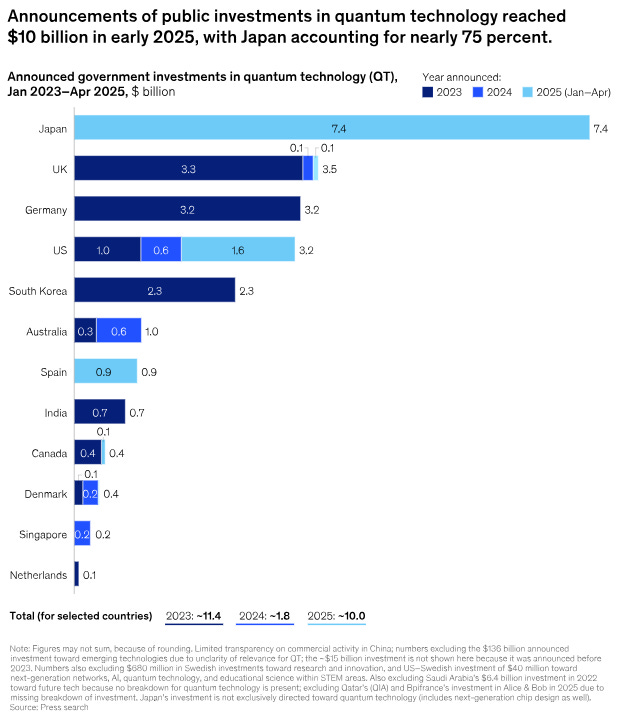
These risks therefore imply a new arms race for states, with enormous investments in quantum computers from both Big Tech and governments. In France, the National Quantum Strategy aims for an investment of €1.8 billion by 2030, of which €1 billion has already been invested between 2021 and 2025. This is a drop in the ocean compared to the €20 billion needed in Europe to hope to rival the investments of the American or Chinese states. Yet, the true financial earthquake came from Japan: at the beginning of 2025, Tokyo announced a colossal public investment of $7.4 billion. Japan alone accounted for nearly 75% of new global public investments announced during this period, totally eclipsing the $3.2 billion budgets shown by Germany or the United Kingdom. Already a pioneer since 1999 thanks to researcher Yasunobu Nakamura, who created the very first superconducting qubit, the nation is mobilizing giants like Fujitsu, Hitachi, and Toshiba to build its own supercomputers and secure its critical infrastructure.
Beyond the infrastructure itself, defense against quantum threats is just as important. Quantum cryptography solutions are being developed to find new encryption algorithms that resist quantum attacks. Research is already well underway, whether on Euclidean lattices, error-correcting codes, or hash functions, to create mathematical problems so complicated that even a quantum computer would have difficulty decrypting them.
However, beyond the technological prowess, economic reality could dampen the enthusiasm of intelligence services. Running a quantum computer with several thousand logical qubits represents a colossal operational cost in terms of energy and cryogenic maintenance. Launching a decryption is not a “free click,” but an investment of tens of thousands of euros per attempt. Imagine the geopolitical dilemma: a state decides to mobilize its rarest resources to “crack” the intercepted data of an opponent or a rival power, only to discover, after days of intense calculation, that the content is just a simple cat “meme” or a parody video. In this new information war, “trolling“ could become a formidable asymmetric defense weapon: saturating adverse servers with useless but heavily encrypted data to push the enemy toward technological bankruptcy. The result of a decryption remains, by nature, uncertain until the last microsecond of the calculation, transforming every quantum espionage attempt into a financial “green carpet” where the stakes are astronomical for a gain that is sometimes derisory.

But then, what are the potential advantages of a quantum computer?
If we strip the quantum computer of its “code-breaker” outfit, its real utility lies in a radically different approach to complexity. One should not imagine this machine as a sprinter running faster than your PC to open your emails, but as an explorer capable of mapping thousands of paths simultaneously in a labyrinth. Its favorite domain is that of combinatorial problems, those mathematical puzzles where the number of possible solutions explodes exponentially as soon as a single new element is added to the equation. It is here that the quantum realm ceases to be a threat and becomes an unprecedented tool for creation, capable of tackling challenges that even the most massive supercomputers can only graze.
The most dizzying application is found in the simulation of matter at the atomic scale, a crucial field for health and materials science. Today, the search for new drugs hits an invisible wall: the space of possible molecules contains approximately 10^30 combinations, a figure that far exceeds the number of stars in the universe. Where a classical computer must test each candidate sequentially, exhausting itself in a screening process that takes years, the quantum processor “speaks” the natural language of matter. Richard Feynman, a famous american physicist, predicted it back then: “Nature isn’t classical, so if you want to make a simulation of nature, you’d better make it quantum mechanical.” This capability could reduce drug discovery cycles from several years to a few hours, while also tackling major climate issues. One thinks notably of global fertilizer production, which currently consumesa vast amount of energy via the Haber-Bosch process; a quantum computer could allow us to understand how bacteria fix nitrogen at room temperature, opening the way to decarbonized agriculture. Similarly, the quest for artificial photosynthesis to capture atmospheric CO2 or the creation of denser batteries and superconductors finally becomes modelable.
This computing power also finds a direct echo in the organization of our hyper-connected societies and the challenge of the “traveling salesman.” Finding the shortest route to deliver to fifty cities is a task so complex that it exceeds the computing capacity of the largest current systems. Yet, the Quantum Supply Chain is no longer an abstract concept but a market being structured. Optimizing the flow of goods, the management of smart grids, or air traffic by just 1% would represent not only billions of euros in savings but also a massive reduction in the environmental footprint. It is this same quest for efficiency that drives the financial sector to invest colossal sums. The goal is to identify asset portfolios with low volatility or to perform “Stress Tests” with surgical precision, detecting systemic risks lurking in the correlations of thousands of assets where our current models see only noise.
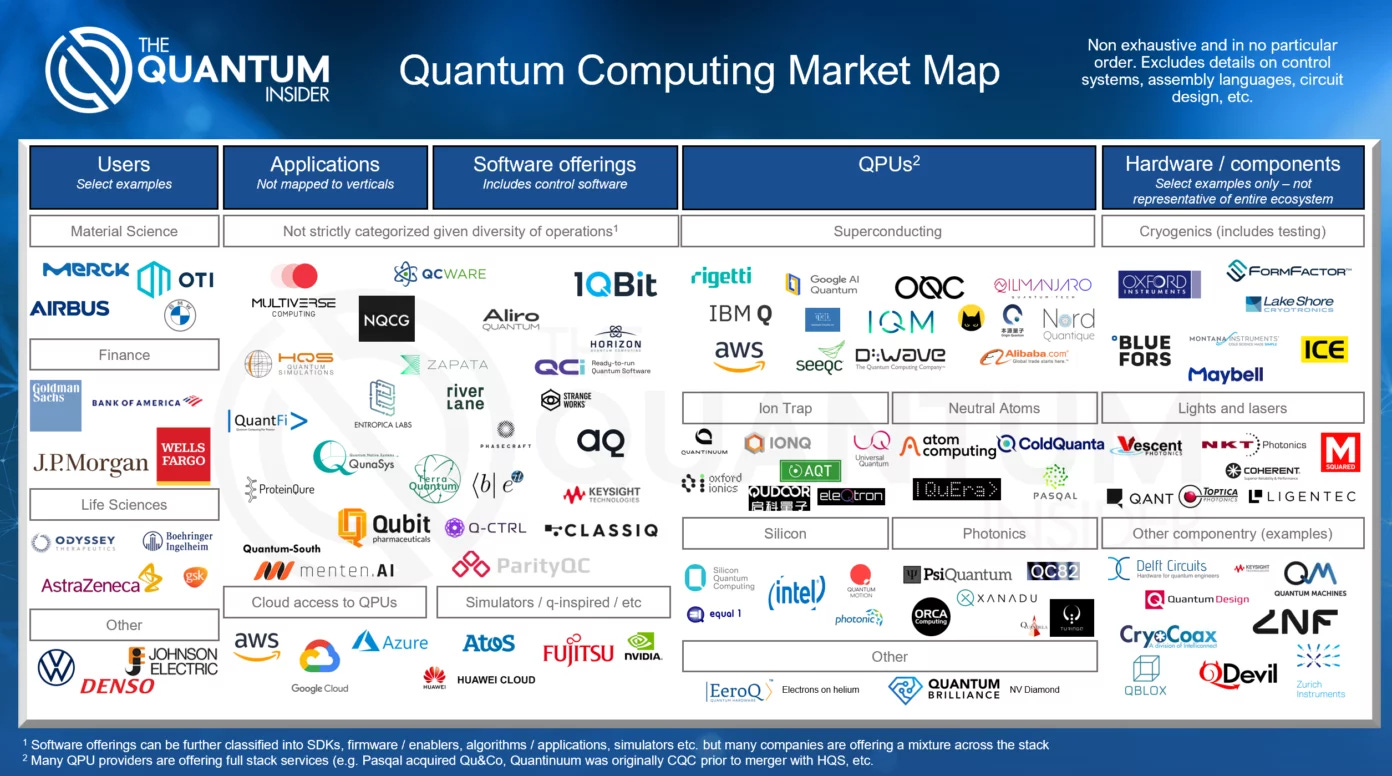
Yet, despite these grandiose promises, where do we really stand in early 2026? The landscape is that of an industry in full transition, seeking to emerge from the era of “noise.” While companies like QuEra have announced processors reaching 3,000 physical qubits and IBM is deploying chips exceeding 1,300 qubits, these figures remain primarily “vanity metrics.” As noted earlier, the technical reality is that a physical qubit remains a fragile entity, susceptible to losing its properties at the slightest cosmic ray or the smallest thermal variation. We are barely entering the era of logical qubits, where thousands of physical qubits are grouped to form a single stable, error-corrected unit. We are currently in a phase comparable to that of computing in the 1950s: we possess the proof that the concept works, we see the first records of “supremacy” on theoretical tasks, but the quantum computer capable of designing the medicine or the battery of tomorrow is still being assembled. Quantum advantage is no longer an illusion, but it remains a monumental construction site whose foundations we are only just laying.
Let’s face it: quantum computing still probably has a long way to go. I was at the Paris Hardware Meetup recently (a great event, by the way, highly recommended), and I heard a PhD student start a pitch with: “I initially started working on quantum computing but pivoted to robotics because I actually want to participate in something that works.” I couldn’t help but laugh.
You can sleep soundly; your own dirty secrets are safe from the quantum computing apocalypse a lot of people try to sell us. But how long will our nation’s secrets last, or the ones of critical companies in defense, energy, or health? Despite a lot of detractors, there is a grand chance that quantum computing does end up working at some point and both risks and rewards will await us.
Another angle I have not tackled in this article is also how could AI capabilities be enhanced by quantum computing? What will this represent in society already shaken by agentic revolution?
Once again, exciting and a little bit scary times ahead.
If you found this analysis valuable, make sure to subscribe and share it with someone who wants to better understand how tech, economy and geopolitics intertwine.