

The Greenland Debacle: How Close Are We to the Edge?
A Plea for a Sovereign Europe: Why the Greenland crisis must be our final wake-up call.

As a devoted aficionada of science fiction and dystopia, I could easily provide my usual list of recommendations, spanning from Ray Bradbury and George Orwell to Margaret Atwood. However, who needs fiction when reality has become stranger than any novel? Welcome to 21st-century geopolitics: a chilling program featuring multiple invasions, diplomatic blackmail, and coercive economic instruments, all set against a backdrop of digital colonization. I hope you like dystopias as much as I do.
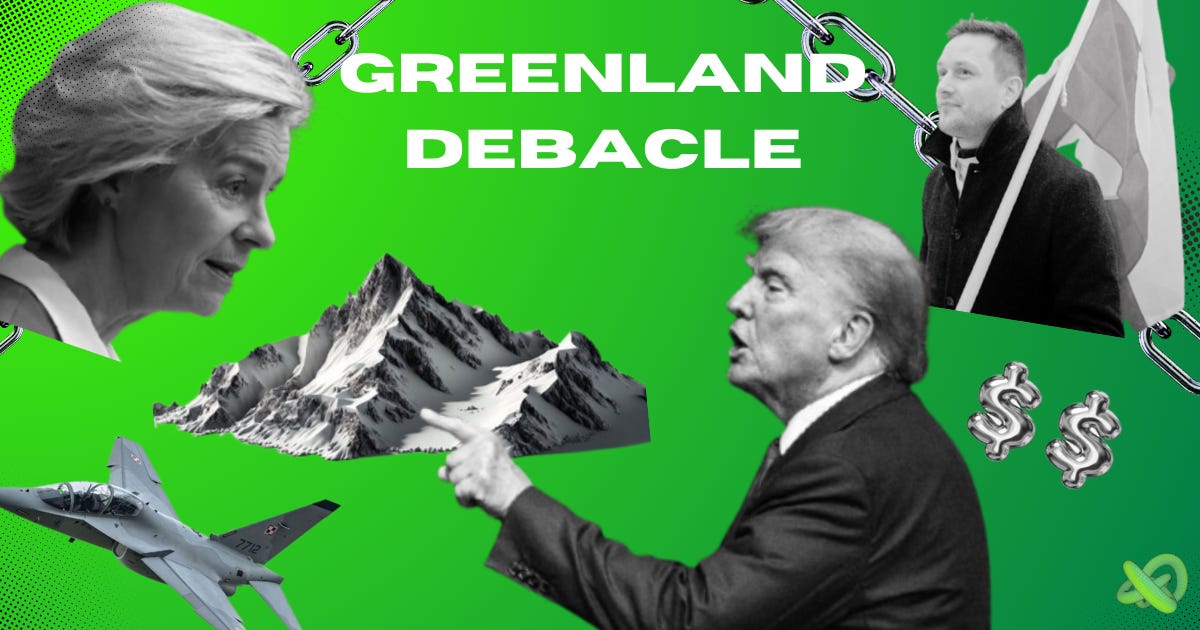
The Arctic Ultimatum
Just days after the abduction of the Venezuelan president, the United States, under the officially all-powerful aegis of Donald Trump, has already identified its next target: Greenland. Under the guise of national security and NATO defense, the White House has deemed the territory “insufficiently protected,” particularly against Russian and Chinese interference. The announcement was met with a glacial reception in Denmark. While Copenhagen is accustomed to the erratic outbursts of President Trump, the Kingdom is not prepared to surrender this vital strategic space to the Americans. Europe, already starved of critical resources compared to predatory competitors like China or Russia, cannot afford to lose this frozen Eldorado. Beyond its strategic spot on the map, Greenland holds the keys to the next century. It is packed with gold, rare earth elements, and polymetallic nodules, not to mention the fact that it sits on roughly 10% of the world's fresh water.
Tensions escalated last week as the announcement was perceived as a direct assault by European Union member states toward its sovereignty. Eight nations (France, Sweden, the Netherlands, Finland, the UK, Norway, Germany, and Denmark) participated in a joint military exercise on-site, a move that clearly irked Washington. The drama continued when an annoyed Trump, labeling the European response as “insolent,” announced new 10% across-the-board tariffs starting this February. These duties could reach a staggering 25% by June 2026, remaining in place until “a deal is reached for the full and complete sale of Greenland.” Indeed, brutal annexation is no longer the primary rhetoric; the talk is now of a territorial purchase, a real estate deal exactly as Donald Trump likes them. Greenlanders have already met his offer with a defiant slogan: "Not for Sale."
This Greenland crisis is unprecedented in an already electric transatlantic context. It marks the first time in NATO’s history that a member state has so openly intimidated an ally by using territorial threats as a bargaining chip, and maybe its biggest crisis in 80 years. We are looking at a potential disintegration that would leave Europe’s eastern flank completely exposed. While theoretically difficult to execute, a forced purchase or annexation of Greenland by the U.S. would create an abyss for world peace and could, through a perverse pendulum effect, drive Europe into the arms of America’s inveterate adversaries.
Above all this crisis represents a total reversal of the geoplitical order we thought we knew. With America joining the game of invasion as Putin on Ukraine and China on Taiwan, there is now three-fifths of the UN Security Council members going for logics of raw power. This "might makes right" philosophy we thought to be dead thanks to globalization has been replaced by an hybrid economic warfare at the centre of a multipolar world where force matters more than international law.
The Painful Awakening of a Vassalized Europe
This geopolitical event serves as a grim reminder: Europe, once a respected power, is losing its cards to American hegemony. One only needs to look back a year ago, almost to the day, when European leaders folded ingloriously in the face of Trump’s previous tariff threats. The question then arises: what real options remain for Europeans? The continent is economically drained by the war in Ukraine and undermined from within by deleterious budgetal management and a sometimes-paralyzing inertia against foreign interference.
However, could a rare situation yield a rare and, hopefully, ambitious response? The “Twenty-Seven” now seem more inclined to respond firmly. The star option on the table is the Anti-Coercion Instrument (ACI). This mechanism allows for various retaliatory measures in cases of commercial blackmail that harms European interests. Never used until now, this instrument could allow for the blocking of certain U.S. investments or the exclusion of American companies from European public tenders. The irony is biting: we may be about to deploy against Washington an instrument originally designed to counter Chinese interference. However, European unity is still paper-thin. While France and the Nordics are pushing to hit back, Italy’s Meloni wants to keep the door open for debate with the Trump administration. Meanwhile, Germany is staying cautious, terrified of what a full-blown trade war would do to its car industry. Nevertheless, the commitments made last summer to reduce European tariffs on American industrial products to zero now seem dead on arrival, while the €93 billion in customs counter-measures initially planned by Europe could finally be activated.
The Digital Colony: Uncle Sam’s Trojan Horse
It is crucial to note, however, that Europe’s fundamental, even systemic, dependence on the U.S. constitutes a latent threat that Trump could activate far beyond trade. Are we on the verge of seeing digital technology used as a frontal geopolitical weapon? With entire sections of our societies relying on American technology, specifically those published by the GAFAM, our defense, healthcare, intelligence, and even our democratic institutions are at stake.
The sad reality is that over the past decade, Europe has become a digital colony of the United States. This patient dismantling of our sovereignty was fueled by the illusion of a “cool” America, masking a predatory reality. We remember the CIA’s pillaging of Gemplus or the forced sale of Alstom’s Energy branch to General Electric. Today, this predation happens in broad daylight, with private acquisitions of our defense crown jewels like Exxelia and Latécoère, healthcare firms like Olink, or semiconductor stars like Graphcore. A quick survey reveals that virtually every strategic sector across all European countries is now under American technological tutelage.
The AI sector is the most current example. While the U.S. captures nearly 75% of global AI investment, our European champions like Mistral are forced to sign strategic partnerships with American giants (Microsoft, in this case) just to survive. The infrastructure required to run these models, both data centers and cutting-edge chips, remains the exclusive domain of American firms. The U.S. CHIPS Act is the perfect illustration: prioritizing American supply chains creates orchestrated shortages for European startups, stifling their development compared to OpenAI or Anthropic.
In legacy sectors, the situation is no better. In healthcare, companies like Microsoft in France or Palantir in the UK host health data or manage entire public health systems at the expense of sovereign solutions like OVHcloud or NumSpot. Even more concerning, the U.S. has the technical capacity to virtually ground entire fleets, a major liability in an increasingly conflicted world. This is the case for F-35s all around Europe, as well as the GPS systems of certain Ukrainian and British missiles. The dependence doesn’t stop there: in intelligence, France entrusts part of its internal security to Palantir, despite its known cooperation with foreign intelligence services whose interests may diverge from ours. American interference also directly attacks our economy by preventing giants like ASML from selling lithography machines to China, resulting in billions of euros in losses for the Dutch giant. Most profoundly, our democracy is being undermined by actors like Elon Musk. His social network, X, notorious for its recent moral failings and affiliation with European hard-right parties, has had a recognized impact on major elections, such as those in Romania.
Of course Europe is not totally defenseless. Beyond the financial weight of SWIFT in Brussels and ASML’s total monopoly on advanced chip-making machines, we run the skies through Airbus and the Galileo satellite network. Our "Brussels Effect" ensures that we don't just consume technology; we set the regulatory standards for privacy and AI that the rest of the world must follow to access our market. We even lead the next energy frontier by hosting the ITER fusion project and dominating the patents for the emerging hydrogen economy. But Europe must remember that it is a powerful continent, and act accordingly.
Finance or Perish
It is necessary, if not vital, for European states to directly or indirectly support sovereign solutions for our ministries, hospitals, banks, schools, and businesses. Private actors also have a fundamental role to play in funding our startups, as seen in the recent $200M raise by Harmattan AI, funded entirely by French defense giant Dassault, or the €1.7 billion Series C for Mistral AI led by European investors. Numerous initiatives are emerging in the VC space through new funds like Wind (Defense & Sovereignty), Balnord (DeepTech), or 55 North (Quantum), but the funding gap remains cavernous. Let’s not forget that American innovative firms raise three times more VC funding than European ones, a gap that widens to eight times in late-stage funding compared to the EU and UK combined. We cannot say we weren’t warned: the 2024 Draghi report on European competitiveness alerted us to the colossal need for additional capital, amounting to €800 billion per year, particularly in breakthrough sectors where the U.S. spends nearly double what Europe does on research. Yet, the political will has been lackluster: only 10% of Draghi’s recommendations have been adopted to date, a pace of progress that is dangerously slow compared to the speed of American protectionism.
Solutions to relaunch our economy exist, but they require urgent and coordinated implementation. This must begin with easing the paralyzing regulations that prevent our startups from focusing on growth. This is the goal of the “28th Regime” and the EU Inc. initiative, a European legal framework allowing innovative companies to overcome market fragmentation without complying with 27 different national regimes. The timing is critical: the vote on the 28th Regime is taking place today, Tuesday, January 20, 2026, at the European Commission. We can only hope that the gravity of recent events pushes for the adoption of the text for implementation by 2027. French President, Emmanuel Macron, doubled down today at Davos by insisting that without a Union of European Markets, our startups will keep flying accross the Atlantic for funding.
Other structural solutions include a massive mobilization of European private savings (estimated at €33 trillion) inspired by the Tibi model in France, through a pan-European pension fund or incentives for insurers to redirect “dormant” savings toward Growth Capital. Public procurement also represents a powerful lever, yet too many European states still rely on American companies for strategic sectors out of convenience. New initiatives like the “Buy European and Sustainable Act” (BESA) aim to establish a community preference in public markets for cloud, AI, and energy transition technologies. Furthermore, the STEP label (Sovereignty Seal) could allow certified companies to benefit from priority access to funding and strategic EU contracts. Finally, there is an absolute necessity to revitalize “exits” for investors. The EU Listing Act reform could radically simplify IPO conditions for scale-ups, with the goal of creating a true “European Nasdaq” to prevent our best companies from fleeing to the NYSE.
As debates heat up and once again highlight Europe’s structural weaknesses, some will cynically rejoice in another Trump victory. Others will say it is too late and the task is insurmountable. But let us stop being bogged down in words: it is time to act. The Greenland debacle is our ultimate stress test. The threat is real, and inertia is no longer a choice; it is a suicide.
If you found this analysis valuable, make sure to subscribe and share it with someone who wants to better understand how tech and geopolitics intertwine.